
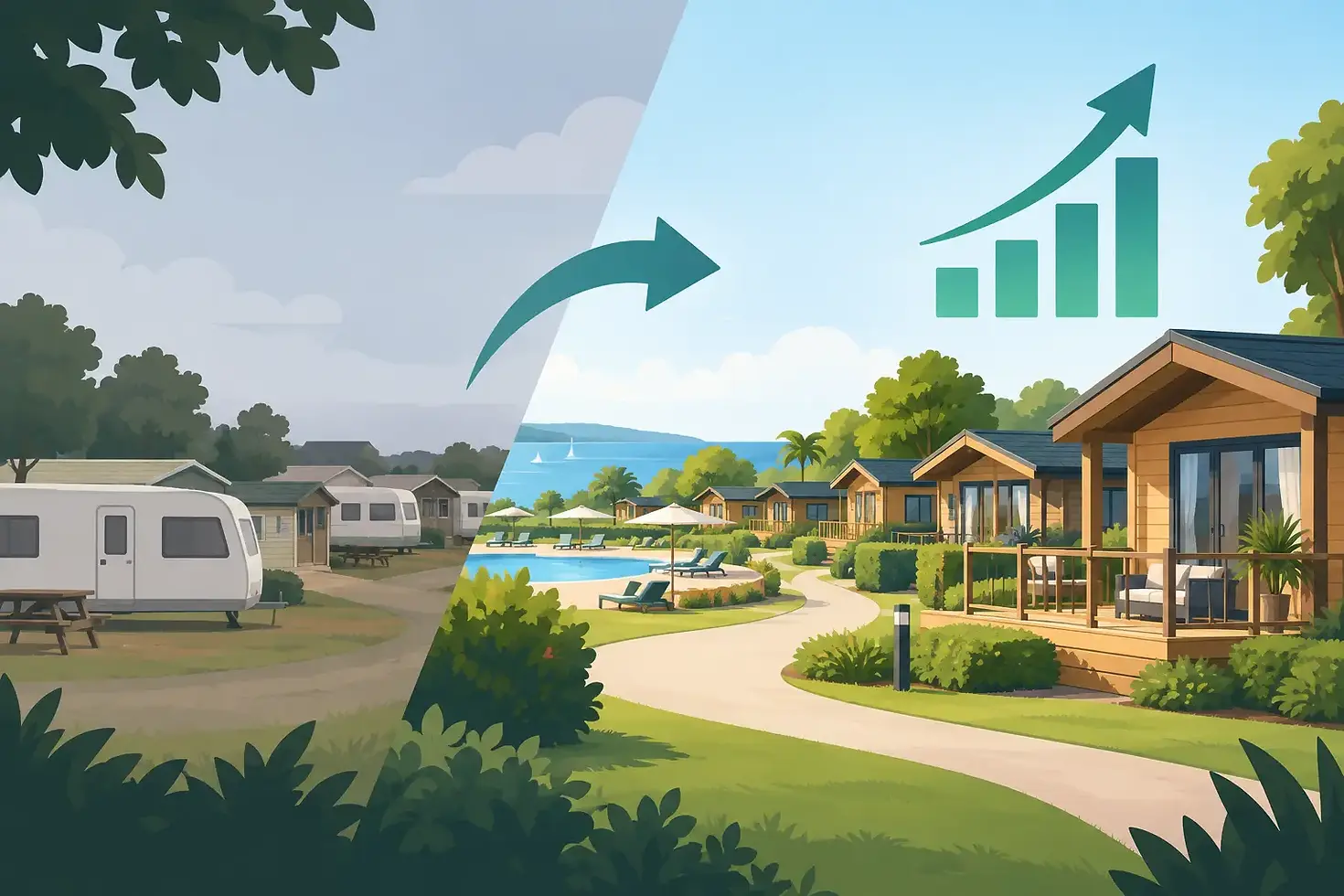
Holiday Park Transformation That Builds Revenue
A holiday park transformation rarely begins with a blank site. More often, it starts with a row of ageing caravans, a corner of underused land, rising maintenance bills and guests whose expectations have moved on. The commercial question is not simply what to replace. It is how to create accommodation that commands stronger rates, costs less to operate and remains an asset for decades.
For UK park owners, the opportunity is substantial. A well-planned modular lodge project can refresh the visual standard of a park, widen its guest appeal and put previously unproductive space to work. Done well, it is a revenue decision with a better guest experience built into it.
Why holiday parks are changing their accommodation mix
Caravans have long been central to the UK holiday park model, but their limitations become clearer as units age. External finishes deteriorate, layouts feel compact, insulation can be poor and refurbishment often becomes a cycle of spending that does little to improve the booking value of the unit. Guests may still accept basic accommodation at the right price, but they increasingly compare holiday parks with well-designed cabins, boutique stays and high-spec short-let properties.
That does not mean every caravan should be removed overnight. Parks with a broad customer base may benefit from retaining entry-level stock while adding premium lodge accommodation for couples, families and longer-stay guests. It depends on location, local demand, seasonality and the rate gap available between standard and upgraded units.
The strongest projects start with a clear commercial aim. It may be replacing the least profitable caravans, introducing year-round rental potential, creating accessible accommodation, or developing a quiet area of land that has never generated income. The lodge is the physical product, but the transformation is the shift in how the site earns.
A holiday park transformation should start with revenue, not footprint
It is tempting to begin by asking how many units a plot can hold. A better starting point is the income profile you want each pitch to deliver. Consider achievable nightly rate, expected occupancy, cleaning and management costs, utility consumption, finance costs and the likely lifecycle of the accommodation.
A larger footprint is not automatically the better investment. One spacious, beautifully finished two-bedroom lodge with private decking, a hot tub position and strong views may produce more value than several tightly arranged units that compromise privacy. Equally, a compact one-bedroom lodge can be an excellent fit for couples’ breaks where the layout feels considered and the outdoor area does the work.
This is where site planning matters. Arrival routes, parking, screening, views, drainage, service connections and the relationship between lodges all affect the guest’s willingness to pay. Outdoor kitchens, pergolas, saunas and landscaped terraces can also turn a standard stay into a bookable experience, but only where they suit the target market and can be operated safely and efficiently.
Replace the maintenance cycle with a longer-term asset
Holiday accommodation needs to look good on changeover day, in poor weather and after years of regular use. That is why build specification should carry as much weight as interior styling. Energy-efficient construction, high-performance insulation, quality windows, durable cladding and a professionally finished interior help reduce the gap between initial purchase price and true ownership cost.
A modern eco lodge should be assessed as a long-life hospitality asset rather than a short-term cabin. Ask about documented construction standards, expected lifespan, thermal performance, warranty cover and the scope of installation. A 30-year guarantee and a design life of 50 years or more can materially change the investment case, provided the terms, maintenance requirements and site conditions are understood from the outset.
Lower running costs matter too. Better insulated accommodation can support comfortable stays through more of the year while reducing heating demand. Where appropriate, solar power and efficient heating systems can further improve operating costs. The right solution depends on the site’s electrical capacity, guest usage patterns and whether the lodge is intended for seasonal or extended occupancy.
Design for the booking photograph and the lived experience
Guests make decisions quickly. The first image must communicate quality, space and a reason to choose your park over another. Contemporary lodge architecture, a calm interior palette and a strong connection to the outdoors create that initial appeal. However, photographs alone do not generate repeat bookings.
The practical experience has to support the promise. Guests notice whether there is somewhere to leave wet coats, sufficient kitchen storage, comfortable seating for the advertised occupancy, useful bedside lighting and a bathroom that feels properly finished. Families need durable surfaces and sensible bedroom layouts. Couples paying for a premium break often value privacy, a generous shower room and an outdoor setting that does not overlook the next unit.
Fully fitted modular lodges offer an advantage here because much of that coordination happens before delivery. Kitchens, bathrooms, heating, lighting and interior finishes can be designed as a complete package rather than assembled through multiple trades on site. This can reduce disruption to park operations and give owners more certainty over the finished standard.
Build a lodge mix around distinct guest demand
A uniform fleet can be simple to manage, but it can limit your audience. A measured mix often performs better: one-bedroom lodges for couples, two-bedroom units for small families, and selected premium plots with enhanced outdoor living features. Accessible layouts may also be valuable, both commercially and as part of a more inclusive park offer.
Avoid adding features simply because competitors have them. Hot tubs can lift rate potential, yet they bring cleaning, servicing, energy and compliance responsibilities. Larger glazing creates impact and can frame a view, but orientation must be considered to prevent overheating or reduced privacy. Premium finishes should be durable enough for high guest turnover, not only attractive in a showroom.
A consultation-led approach helps turn these choices into a coherent accommodation strategy. At Lifestyle Eco Lodges Europe, projects are planned around the site, the intended guest and the commercial result, with fully installed modular accommodation selected to suit the opportunity rather than forced into a standard template.
Deliver the project with minimal disruption
Traditional construction can create extended noise, wet trades, vehicle movements and uncertainty around programme. For a live holiday park, this affects guests as well as staff. Modular construction moves much of the building process into a controlled factory environment, allowing site work and unit manufacture to progress in a more coordinated way.
That does not make planning and preparation optional. Groundworks, foundations, drainage, utilities, access for delivery and lifting, and local planning or licensing requirements all need to be resolved early. Depending on the proposal and local authority, a new lodge may require planning permission or need to meet particular conditions relating to use, siting and occupancy. Never assume that a previous caravan pitch automatically permits a different form of accommodation.
The most dependable programmes separate the work into clear stages: feasibility and site review, lodge selection, approvals, ground preparation, manufacture, delivery, installation and final commissioning. This provides realistic expectations for when accommodation can enter the booking calendar. Rapid installation is valuable, but only when the infrastructure is ready to receive the lodge.
Measure success beyond the opening season
A transformation should be judged after the first glossy photographs have done their job. Track achieved average daily rate, occupancy, length of stay, guest review themes, utility use, maintenance calls and booking lead time. Compare the performance of upgraded accommodation with the stock it replaced, not only with the park-wide average.
This information guides the next phase. If couples’ lodges consistently book first, there may be a case for more intimate premium units. If family bookings produce the best annual return, a larger two-bedroom configuration may deserve priority. If energy use is higher than forecast, operational settings and guest guidance may need attention before further investment.
A successful holiday park transformation is not about filling every available square metre. It is about making each developed pitch work harder, look better and remain easier to operate. Start with the guest you want to attract, test the numbers against the whole life of the building, and choose accommodation that gives your park room to grow with confidence.


Comments